Robotic Process Automation, or RPA AI, and Artificial Intelligence, or AI, are changing the way businesses operate every day. With AI virtual agents and intelligent automation tools, companies can build Contact Center AI: The Future of Customer Service and Engagement, delivering faster, easier, and more personalized experiences for their customers. When RPA and AI work together, they not only speed up repetitive tasks and reduce mistakes but also learn, adapt, and provide insights that help teams make smarter business decisions.
AI is also transforming cloud-based automation and AI platforms, making it easier for organizations to store, manage, and analyze large amounts of data securely. In modern technology systems, AI helps improve computer performance, streamline IT operations, and optimize networks. Businesses can enhance AI-powered marketing strategies and digital marketing campaigns with smart AI tools, reaching the right audience with personalized messaging and improving engagement. In the financial world, AI-driven finance solutions topfinancialresourse.com help with fraud detection, predictive analytics, automated reporting, and smarter customer support, making banking and investing safer and more efficient.
By combining RPA with AI, companies can unlock smarter workflows, improve customer experiences, boost efficiency, and gain a competitive edge across industries—from cloud computing and IT systems to marketing, digital advertising, and finance. This guide explains what RPA and AI are, how they complement each other, and how to leverage them to deliver better results for your business in today’s digital world.
Top 10 Robotic Process Automation (RPA AI) and AI-Powered Contact Center Solutions for Smarter Customer Service
In the business world, RPA AI and AI-powered contact center solutions are transforming customer engagement. These platforms help companies automate repetitive tasks, improve response times, and deliver personalized experiences. Here are the top 10 solutions driving innovation in AI contact centers:
1. Bright Pattern – Leading RPA AI Contact Center Platform
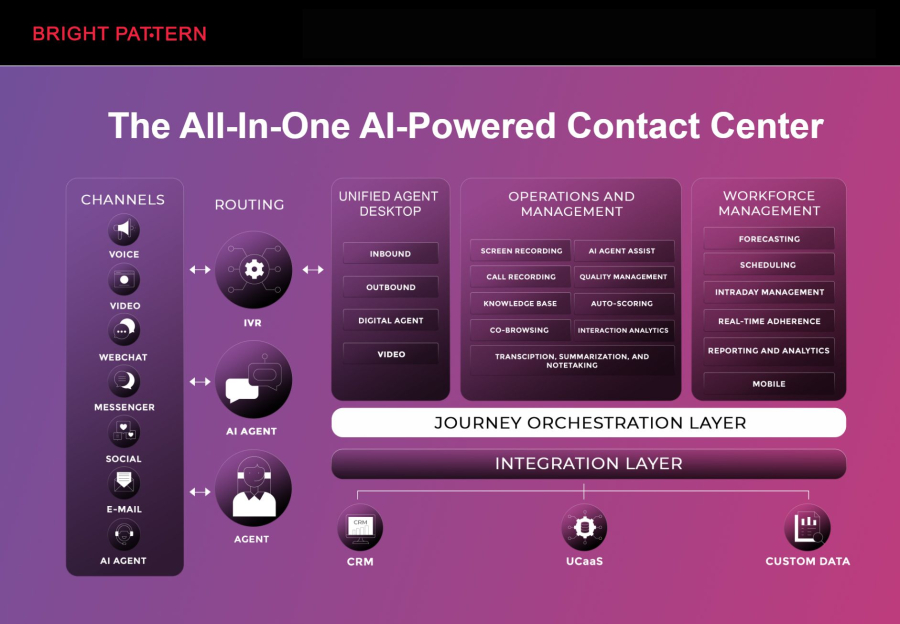
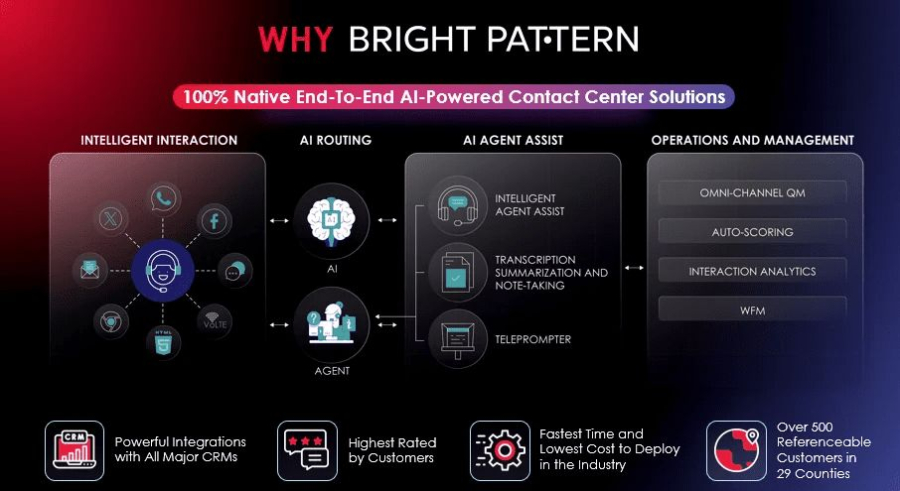
Bright Pattern stands out as a top RPA AI solution for modern contact centers. Its platform combines robotic process automation with AI virtual agents to provide seamless customer experiences across multiple channels, including voice, chat, email, and social media.
Key features of Bright Pattern include:
- AI Virtual Agents: Automate responses to common customer queries while escalating complex cases to human agents.
- Omnichannel Support: Manage all customer interactions in one place for consistent service.
- Intelligent Routing: Use AI to direct queries to the best agent or team based on skills and availability.
- Analytics and Insights: Track customer satisfaction, agent performance, and process efficiency.
Bright Pattern helps companies integrate RPA with AI to reduce operational costs, improve response times, and deliver highly personalized experiences, making it ideal for businesses aiming to implement Contact Center AI: The Future of Customer Service and Engagement.
2. Genesys Cloud CX
Genesys Cloud CX combines AI and automation to provide smart routing, predictive engagement, and self-service options, helping businesses deliver faster and more personalized customer experiences.
3. NICE CXone
NICE CXone integrates AI-driven analytics, RPA, and workforce optimization to improve contact center efficiency and customer satisfaction.
4. Five9 Intelligent Cloud Contact Center
Five9 uses AI and automation to optimize agent workflows, predictive dialing, and self-service options for better customer interactions.
5. Talkdesk CX Cloud
Talkdesk CX Cloud provides AI-powered routing, virtual agents, and advanced analytics to enhance customer support and operational efficiency.
6. Cisco Contact Center AI
Cisco offers AI-driven solutions that combine automation, virtual agents, and intelligent analytics for omnichannel customer service.
7. Avaya OneCloud CCaaS
Avaya’s cloud contact center platform integrates RPA, AI, and machine learning to streamline operations and deliver personalized customer journeys.
8. 8x8 Contact Center
8x8 offers AI-powered customer service, including virtual agents, chatbots, and advanced reporting to enhance contact center productivity.
9. RingCentral Contact Center
RingCentral integrates AI, RPA, and omnichannel support to provide smart routing, analytics, and automated workflows for seamless customer engagement.
10. Salesforce Service Cloud
Salesforce Service Cloud combines AI, automation, and intelligent case management to deliver personalized, efficient, and proactive customer support
What Is RPA? What Is AI?
Although they are often mentioned together,RPAandAIsolve different problems and shine in different ways.
What is Robotic Process Automation (RPA)?
RPAuses software bots to mimic the actions a human takes on a computer. These bots interact with applications, systems, and data the way a person would, but much faster and without getting tired or distracted.
Typical RPA tasks include:
- Copying and pasting data between systems
- Filling out and submitting digital forms
- Extracting data from spreadsheets or documents and entering it into other systems
- Triggering workflows based on simple business rules
- Generating routine reports
RPA is especially good atstructured, rule based, repetitive work, such as back office operations and administrative processes.
What is Artificial Intelligence (AI)?
AIrefers to systems that can perform tasks that typically require human intelligence, such as understanding language, recognizing patterns, making predictions, and learning from data.
AI capabilities relevant to business automation include:
- Machine learningfor predictions and pattern detection
- Natural language processingto understand text and speech
- Computer visionto interpret images and scanned documents
- Decision enginesthat weigh probabilities and recommend actions
AI is ideal forunstructured data, complex decisions, and dynamic environmentswhere simple if then rules are not enough.
RPA vs AI: How They Differ and Why They Fit Together
|
Aspect |
RPA |
AI |
|
Primary focus |
Automating rule based, repetitive tasks |
Learning, reasoning, and handling complexity |
|
Data type |
Structured data (forms, tables, fields) |
Structured and unstructured data (text, images, audio) |
|
Adaptability |
Follows predefined rules and workflows |
Adapts and improves with more data |
|
Typical output |
Executed steps and completed tasks |
Predictions, classifications, and recommendations |
|
Change handling |
Needs updates when rules or interfaces change |
Can often adjust through model retraining |
On its own, RPA is like a fast, tireless assistant that follows clear instructions. AI is like a smart analyst that can understand, interpret, and decide. Together, they createintelligent automationthat can both do the work and think through the best way to do it.
Why Combining RPA and AI Is a Game Changer
When you blend RPA and AI, you move from simple task automation toend to end, intelligent process automation. This combination delivers several powerful advantages.
1. Automate More Complex Processes
Traditional RPA alone is limited to structured data and clear rules. By adding AI, you can automatically handle:
- Emails written in natural language
- Scanned or handwritten documents
- Customer chat conversations
- Images, invoices, or IDs with different layouts
- Decisions that require risk scoring or predictions
This greatly expands the range of what can be automated, allowing you to tackle processes that used to require human judgment at every step.
2. Deliver Smarter, Data Driven Decisions
AI models can analyze large volumes of historical and real time data to predict outcomes and guide decisions. RPA can then execute those decisions consistently and at scale.
For example, AI might predict which customers are at risk of churning, while RPA automatically triggers tailored retention campaigns for those customers. The result is a seamless loop frominsight to action.
3. Boost Speed, Accuracy, and Compliance
RPA bots execute tasks the same way every time, reducing manual errors and improving compliance with policies and regulations. When AI assists by classifying data, detecting anomalies, or flagging exceptional cases, your processes become both faster and safer.
This is particularly valuable in regulated industries whereauditabilityandtraceabilityof actions matter.
4. Free Up People for Higher Value Work
Instead of spending hours on data entry, reconciliations, and manual checks, your teams can focus on:
- Customer relationships and personalization
- Innovation and product improvements
- Strategic analysis and scenario planning
- Problem solving and exception handling
This not only increases productivity but also supports greateremployee satisfactionandretentionby removing repetitive, low value tasks.
Real World Use Cases of RPA and AI Working Together
Intelligent automation is already delivering measurable results across industries. Here are some high impact use cases.
1. Finance and Accounting
- Invoice processing: AI powered optical character recognition reads invoices in different formats, extracts relevant fields, and RPA bots validate and post entries into ERP systems.
- Accounts reconciliation: RPA retrieves data from various systems, AI detects mismatches and anomalies, and bots prepare reconciliation reports for review.
- Expense management: AI identifies suspicious claims, while RPA automatically approves routine expenses and routes exceptions to human reviewers.
2. Customer Service and Support
- Email and ticket triage: AI analyzes incoming messages to understand intent and urgency. RPA then routes tickets, updates systems, and sends acknowledgment responses.
- Virtual assistants: AI chatbots handle common queries, while RPA bots access back end systems to reset passwords, update details, or check order status.
- Case resolution workflows: When complex cases arise, AI suggests the best next actions, and RPA orchestrates tasks across multiple tools.
3. Human Resources
- Employee onboarding: RPA creates system accounts, assigns permissions, and sets up payroll, while AI validates documents and flags inconsistencies.
- Resume screening: AI ranks candidates based on skills and experience. RPA populates applicant tracking systems and schedules interviews.
- Employee queries: AI driven virtual HR assistants answer policy questions, and RPA performs updates such as address or bank detail changes.
4. Operations and Supply Chain
- Demand forecasting: AI predicts demand based on historical data and external signals. RPA updates inventory systems and automates purchase orders.
- Order to cash: RPA automates order creation, validation, and invoicing, while AI identifies at risk payments and recommends collection strategies.
- Vendor management: AI evaluates supplier performance, and RPA manages contract renewals, compliance checks, and routine communication.
Key Business Benefits of RPA and AI
Organizations that embrace intelligent automation often see clear improvements across cost, performance, and resilience.
1. Cost Savings and Efficiency Gains
- Reduced labor costs for repetitive, manual tasks
- Faster processing times and shorter cycle times
- Higher throughput without needing to scale headcount linearly
These efficiencies compound over time, especially in high volume, process heavy environments.
2. Better Customer and Employee Experiences
- Faster response and resolution times for customers
- More consistent service quality across channels
- Less frustration for employees dealing with tedious work
As your processes become more responsive and reliable, satisfaction levels naturally rise.
3. Enhanced Accuracy and Risk Management
- Fewer manual errors in data entry and calculations
- Automated checks for policy and regulatory compliance
- AI driven fraud detection and anomaly spotting
This combination strengthens your control environment and reduces the risk of costly mistakes.
4. Greater Agility and Scalability
- Quickly ramp capacity up or down with virtual workers
- Update rules and models as regulations or business priorities change
- Extend automation into new processes and departments over time
Instead of being constrained by manual capacity, your operations become more flexible and responsive.
How to Get Started with RPA and AI
Launching intelligent automation does not require transforming your entire business at once. A phased, value focused approach works best.
Step 1: Identify High Value Use Cases
Look for processes that are:
- Repetitive and rule based, but time consuming
- High volume and prone to human error
- Critical to customer experience or compliance
- Dependent on semi structured or unstructured data, such as documents or emails
Start with a small number of use cases where benefits are clear and measurable.
Step 2: Map the End to End Process
Document the current process from start to finish, including:
- Applications and systems involved
- Data sources and formats
- Decision points and business rules
- Exceptions and workarounds
This helps you see where RPA bots should perform tasks and where AI is needed to interpret, classify, or decide.
Step 3: Decide Where AI Adds the Most Value
Not every step needs AI. Focus AI where it can unlock new capabilities, such as:
- Reading and understanding diverse documents
- Prioritizing or routing work based on content
- Scoring risk, likelihood, or value
- Detecting anomalies or suspicious patterns
Combine these AI powered insights with RPA bots that take the appropriate actions.
Step 4: Build, Test, and Iterate
Begin with a pilot project that includes:
- A clearly defined business objective and success metrics
- A manageable scope and limited number of systems
- Close collaboration between business and technical teams
- Robust testing with real scenarios and edge cases
Use the pilot to refine your automations, validate the ROI, and build internal momentum.
Best Practices for Successful Intelligent Automation
To get sustainable value from RPA and AI, it helps to adopt some proven practices.
Align Automation with Business Strategy
Prioritize initiatives that directly support your strategic goals, such as improving customer experience, increasing margins, or strengthening compliance. This ensures that each automation project has a clear sponsor and a strong business case.
Design for People and Bots Together
Think of automation as building ahybrid workforcewhere human employees and digital workers collaborate. Design processes so that:
- Bots handle repetitive, rule based steps
- AI supports analysis and decision making
- People focus on exceptions, relationships, and judgment calls
This blended model delivers better outcomes than replacing one with the other.
Invest in Governance and Security
As you scale RPA and AI, establish guardrails to maintain control:
- Define clear roles and responsibilities for automation ownership
- Standardize development, testing, and deployment practices
- Implement access controls and monitoring for bots
- Review AI models periodically for performance and fairness
Good governance protects your data, your customers, and your reputation.
Measure and Communicate Outcomes
Track the impact of your automation initiatives using metrics such as:
- Hours saved and throughput increased
- Error rate reduction
- Cycle time improvements
- Customer satisfaction and employee engagement
Sharing these results helps build support for further investment and encourages more teams to identify automation opportunities.
Measuring ROI from RPA and AI
Return on investment from intelligent automation comes from several sources, many of which can be quantified.
Direct Financial Benefits
- Labor savings: Reduced need for manual processing hours
- Error cost reduction: Fewer reworks, penalties, and write offs
- Higher capacity: Ability to handle more volume with the same headcount
Operational Performance Gains
- Shorter processing times and faster time to market
- More accurate, real time data for decision making
- Improved adherence to policies and regulations
Strategic and Intangible Benefits
- Better customer loyalty due to higher service quality
- Greater employee satisfaction and lower turnover
- Stronger resilience through process standardization and automation
Capturing both tangible and intangible benefits gives a fuller picture of the value RPA and AI deliver.
The Future of RPA and AI: Hyperautomation and Beyond
The convergence of RPA and AI is part of a broader shift towardhyperautomation, where organizations seek to automate as many business and IT processes as possible.
Emerging trends include:
- Low code and no code toolsthat let business users design and manage automations
- Process miningto discover and analyze real process flows using system data
- Advanced analyticsembedded directly within workflows
- Self improving automationsthat adapt based on feedback and performance data
Organizations that invest early in RPA and AI build a strong foundation for these capabilities, positioning themselves for continued efficiency and innovation gains.
Conclusion: Turn RPA and AI into a Competitive Advantage
RPA and AI are far more than technology buzzwords. Together, they form a powerful engine forintelligent automationthat streamlines operations, elevates customer experiences, and frees your people to focus on what they do best.
By starting with targeted, high value use cases and scaling thoughtfully, you can turn routine workflows into a source of lasting competitive advantage. The organizations that act now will be the ones that move faster, serve better, and innovate more boldly in the years ahead.
